
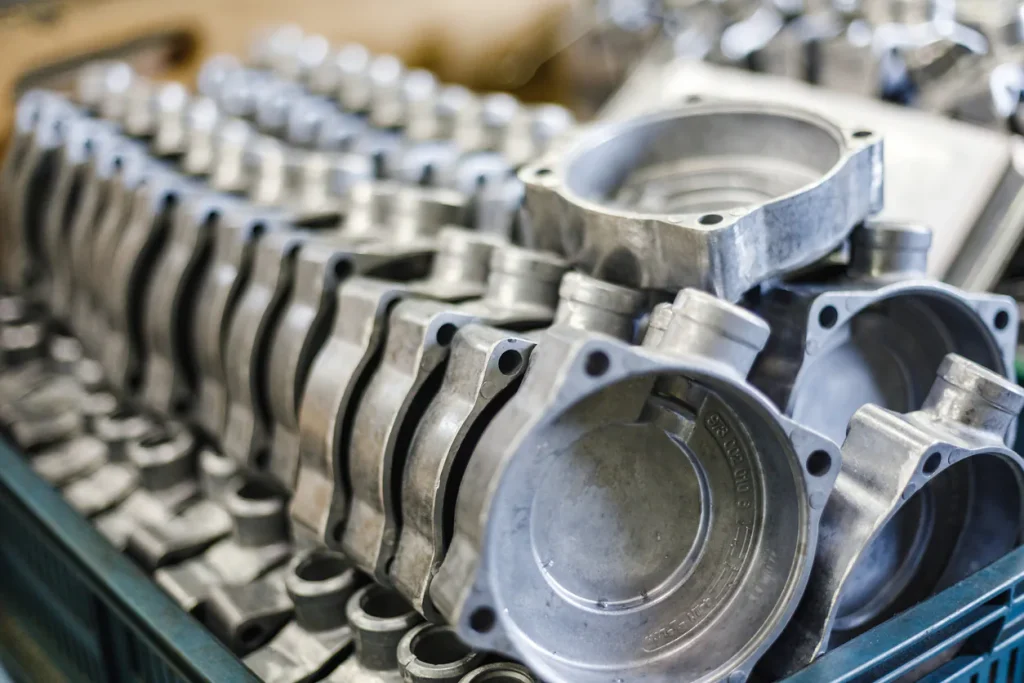
One of the biggest decisions you will make when launching a new project is choosing the cavitation of your die cast tooling. The number of cavities in the die affects the cost of your die, casting price, and the life of your tooling.
Die casting tooling cost includes more than the first die. Replacement cavities and piece price add up over the life of a program. A die with more cavities costs more up front, but it can lower the total cost of the project.
General Die Casters, part of the GD Casting Group, breaks down the three factors that decide how many cavities your die should have and how each one affects cost.
How Many Cavities Should a Die Cast Tool Have?
For high-volume parts, more cavities usually lowers the piece price and the total project cost. For complex or lower-volume parts, fewer cavities often make more sense.
- Size of the casting: The projected area sets the machine tonnage, and larger machines cost more to run.
- Complexity of the part: Slides, tight tolerances, and difficult geometry limit how many cavities are practical.
- Expected annual usage and life of the program: High volumes favor more cavities. Lower volumes often favor fewer.
Size of the Casting
Machine size depends on the projected area at the parting line, not the weight of the casting. That area includes the part, runner, and venting. The pressure applied to this area is the force the casting machine must overcome when injecting the metal.
The image below shows the part, gate, and venting system of an 8-cavity die. The projected area of this shot is 214.6 square inches.
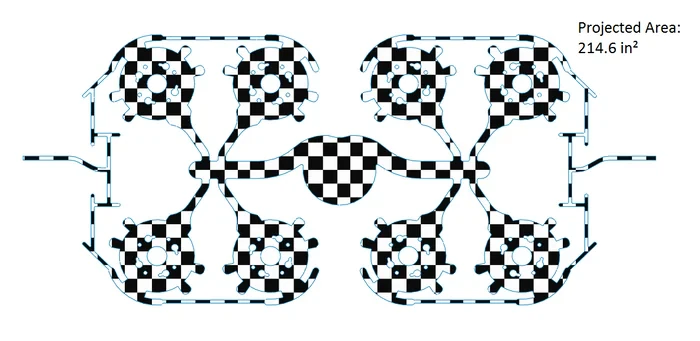
Projected area of an 8-cavity shot: 214.6 square inches.
We also need to know the metal pressure required to produce this casting. Many castings are produced with 10,000 to 12,000 PSI of metal pressure.
To find the tonnage this 8-cavity design requires, multiply the projected area by the metal pressure, then divide by 2,000 to convert pounds to tons.
Machine Tonnage Required = (Projected Parting Line Area x Metal Pressure) / 2,000
This design requires (214.6 x 10,000) / 2,000 = 1,073 tons. The formula gives an estimate, not an exact number, so this design would still run on a 1,000-ton machine.
Bigger dies need bigger machines, and that can change the cost.
Machines from 400 to 1,000 tons are very common in the die casting industry. Machines from 1,200 tons and greater are less common and are typically used for high-volume automotive work. They cost much more to buy and run, which raises the piece price. Many of them were purchased to produce a specific large casting, such as an engine block or transmission case. A 50-cavity die of your part might be possible on a 3,000-ton machine, but large machines are usually reserved for large, high-volume castings.
During quoting, the die caster runs a cost evaluation to find the lowest-cost option for the customer on its equipment.
How Cavity Count Affects Die Casting Tooling Cost
The part shown above could be produced in a 2, 4, or 8-cavity die. The table below shows how cavitation affects tooling and casting price. The dollar amounts are conceptual. They are meant to show the decision-making logic, not to quote actual prices.
Cavitation Cost Comparison (Illustrative)
| 2-Cavity | 4-Cavity | 8-Cavity | |
|---|---|---|---|
| Machine size (tons) | 400 | 600 | 1,000 |
| Estimated annual usage | 500,000 | 500,000 | 500,000 |
| Cycle time | 30 seconds | 40 seconds | 50 seconds |
| Annual hours required | 2,083 | 1,388 | 868 |
| Machine cost per hour | $250 | $312.50 | $375 |
| Piece cost without metal | $1.04 | $0.87 | $0.65 |
| Tooling cost | $84,000 | $119,000 | $154,000 |
| Tool life yield (100,000 shots, 5% scrap) | 190,000 | 380,000 | 760,000 |
| Project life | 5 years | 5 years | 5 years |
| Replacement cavities required | 14 | 7 | 4 |
| Total project tooling cost | $728,000 | $588,000 | $392,000 |
| Total project casting cost | $2,600,000 | $2,175,000 | $1,625,000 |
| Total project cost | $3,328,000 | $2,763,000 | $2,017,000 |
While the 8-cavity die has the highest upfront tooling cost, it has the lowest total cost for the project. The savings come mostly from tool life. Each die in this example yields about 100,000 shots with 5% scrap, so a 2-cavity die produces 190,000 good parts before it needs replacement cavities, while an 8-cavity die produces 760,000. The 8-cavity die needs far fewer replacements over five years.
Each time replacement cavities are built, they must be sampled and PPAP approved. Plan for that cost too.
Complexity of the Casting
Slides, tight tolerances, and difficult geometry can all limit how many cavities make sense.
Number of Slides
If the casting has multiple slide cores, it limits the number of cavities you can use. The moving slide mechanisms take up space in the die, which leaves less room for more cavities.
The image below shows a 2-cavity die with 4 slides on each cavity. Each added slide makes the die more complicated. A 4-cavity version of this die is possible, but the extra downtime that comes with a more complicated die can offset the benefit of the added cavities. The other option is to run two 2-cavity dies in two casting machines to meet the volume, though the cost per piece may be higher. Choosing between them is a risk, cost, and benefit decision.
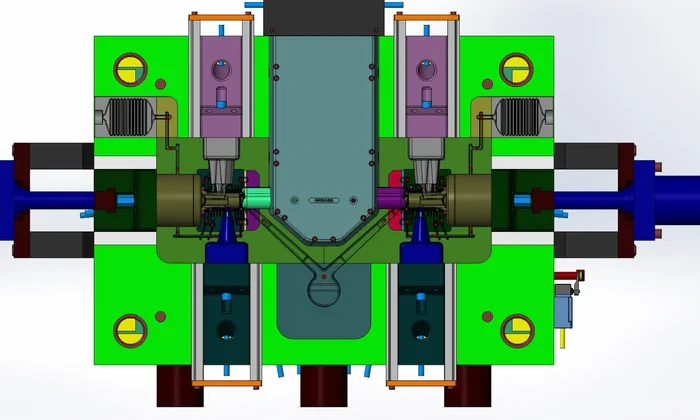
A 2-cavity die with 4 slides on each cavity.
Dimensional Control
Each added cavity makes dimensional consistency harder. Let’s say your casting has 4 features that must hold a tight tolerance. That is very manageable in a 2-cavity die, with 8 critical features per machine cycle. In an 8-cavity die, you have 32 critical features to control each cycle. It can be done, but it often requires much more frequent die maintenance, which adds cost, especially when each cavity has one or more slides.
Difficult Geometry and Quality Requirements
With each added cavity, the runner and venting system becomes harder to design. The die caster engineers the runner to fill each cavity at the same time. Even with modern computer modeling, optimizing runners and venting on high-cavity dies is difficult. The die caster may advise against more cavities when it would compromise quality.
Annual Usage and Program Life
Our earlier example used a high-volume casting at 500,000 pieces per year. The economics change when the part is lower volume. Let’s say the volume is 15,000 pieces per year over a 5-year project life. In this example, the lowest project cost is a 2-cavity die.
At lower volumes, a smaller die may last most or all of the program with few or no replacement cavities, so the higher upfront cost of a larger die may not pay for itself.
Find the Right Die Cast Tooling With General Die Casters
The right cavity count depends on your part and your volumes. Go over the cavitation options with your die caster before you begin. General Die Casters, part of the GD Casting Group, walks through these options with you during quoting.
Talk to our Sales and Tooling Engineers about your next die casting project.
Die Cast Tooling FAQs
How do you calculate the machine tonnage for a die cast part?
Multiply the projected area of the part, runner, and venting at the parting line by the metal pressure, then divide by 2,000 to convert to tons. The result is the minimum clamping force the machine needs to hold the die closed during injection. The die caster uses this number to pick a machine size during quoting.
Does a die with more cavities always cost less overall?
No. More cavities usually lower the total project cost for high-volume parts. For lower volumes, complex parts with slides, or parts that would need a much larger machine, fewer cavities can cost less over the life of the program.
What adds to die casting tooling cost besides the first die?
Replacement cavities are a major added cost over the life of a program. Each replacement must be sampled and PPAP approved before production. High-cavity dies with tight tolerances may also need more frequent die maintenance.