
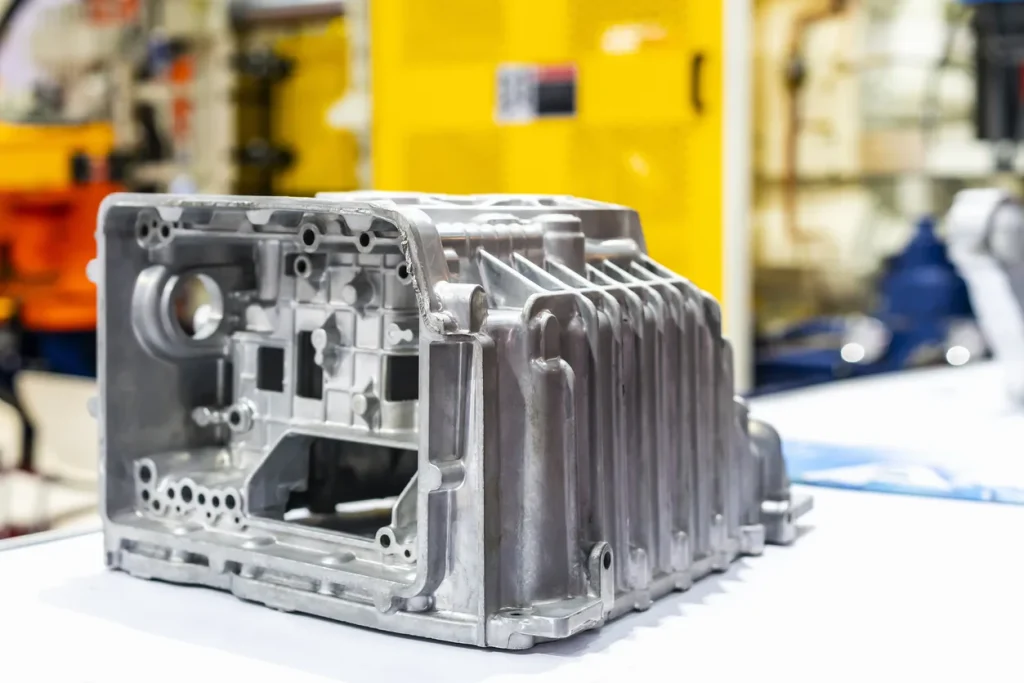
Die casting as a manufacturing method has multiple methods, each of which is best suited for specific part sizes, timelines, material selections, and more. Cold chamber vs hot chamber die casting is a pivotal conversation for customers to have, but that can only happen when both processes are known and explained.
While both cold chamber and hot chamber die casting feature similar aspects, such as the melted metal material injected into a die and there is high pressure throughout. However, there are key differences. Mainly, how the melted material is delivered into the die.
General Die Casters provides information on both operations, the importance of each, and considerations to make that can help guide your team to selecting the right process for your program.
How Hot Chamber Die Casting Works
If your team is considering hot chamber die casting, it’s critical to know from the beginning that hot chambers support specific materials. Zinc, magnesium, lead, and tin are some of the most commonly used materials because they feature low melting points.
In hot chamber operations, an injection system featuring a gooseneck and plunger is used to injection the molten metal into the die. This injection system sits submerged with the melted material and is already inside the system. Unlike a cold chamber, hot chamber die casting doesn’t feature a ladling step which can support faster cycle times and is a bit more suitable for small, high-volume parts.
How Cold Chamber Die Casting Works
The cold chamber vs hot chamber die casting conversation can begin with a close look at cold chamber die casting. In this path, the material – usually aluminum since it features a high melting point – is melted into a separate furnace. From there, the melted material is ladled into a shot sleeve for each cycle and those shots are injected into the die.
The critical note is that the plunger, which injects the material into the die, and other injection components aren’t constantly exposed to the melt. This protects the system and promotes equipment longevity, which aids in repeatable manufacturing.
At General Die Casters, our infrastructure features automatic ladles, servo shot control, and Fondarex vacuum on our cold chamber machines. These pieces of equipment help streamline operations, minimize error, and protect equipment.
Why Aluminum Requires Cold Chamber
Molten aluminum attacks and dissolves iron which would cause a submerged steel gooseneck to quickly fail. Whereas zinc works for hot chamber systems since it runs at a much lower temperature. However, there are some zinc alloys that feature high aluminum levels and are better suited for cold chamber operations.
Cold Chamber vs. Hot Chamber: Key Differences
| Comparison Factor | Cold Chamber Die Casting | Hot Chamber Die Casting |
|---|---|---|
| Typical alloys | Aluminum | Zinc and other low-melting-point metals |
| Metal handling | External furnace and ladle | Integrated melt pot |
| Cycle time | Slower than hot chamber die casting | Faster cycle times |
| Typical part size | Handles larger parts | Smaller parts |
| Machine size and tonnage | Covers a much larger tonnage range | Smaller tonnage range |
| Strength and weight | Compare aluminum strength and weight requirements | Compare zinc strength and weight requirements |
| Tooling life, surface finish, and plating suitability | Evaluate tooling life, surface finish, and plating requirements | Evaluate tooling life and surface finish; zinc is excellent for plating |
| Cost per part at volume | Compare cost per part at the required production volume | Compare cost per part at the required production volume |
When Cold Chamber Is the Better Fit
Cold chamber vs hot chamber die casting on its face truly means selecting the process that best fits your needs. For cold chamber die casting, this starts off with aluminum being the known material.
Cold chamber casting does more than just support aluminum, however. Large or structural parts such as housings, brackets, or EV components benefit from cold chamber operations. If strength-to-weight ratios are critical, as well as specialized heat treatments, cold chamber die casting works well too.
Lastly, any manufacturing programs that need CNC machining, finishing, and assembly after casting also benefit from cold chamber casting.
When Hot Chamber May Fit Better
The hot chamber die casting crowd is more often going to attract manufacturing programs that feature small and intricate high-volume zinc parts. If fast cycle times are the main driving point because of cost, this is an option to consider.
Find the Right Die Casting Process for Your Part with General Die Casters
Since 1957, General Die Casters has specialized in manufacturing high-quality aluminum die casting operations. Through strategic partnerships with OEMs, supplier programs, and other customer sources, our die cast components have been featured in numerous applications throughout a variety of industries.
General Die Casters utilizes nearly 20 different types of cold chambers for our die casting operations in our Twinsburg, Ohio facility. Our manufacturing operations are backed by stringent quality management systems that feature in-line inspection, part validating, and documentation as necessary.
Contact our team today for more information on the specifics of our cold chamber die casting capabilities and how we can be the right partner for you.