
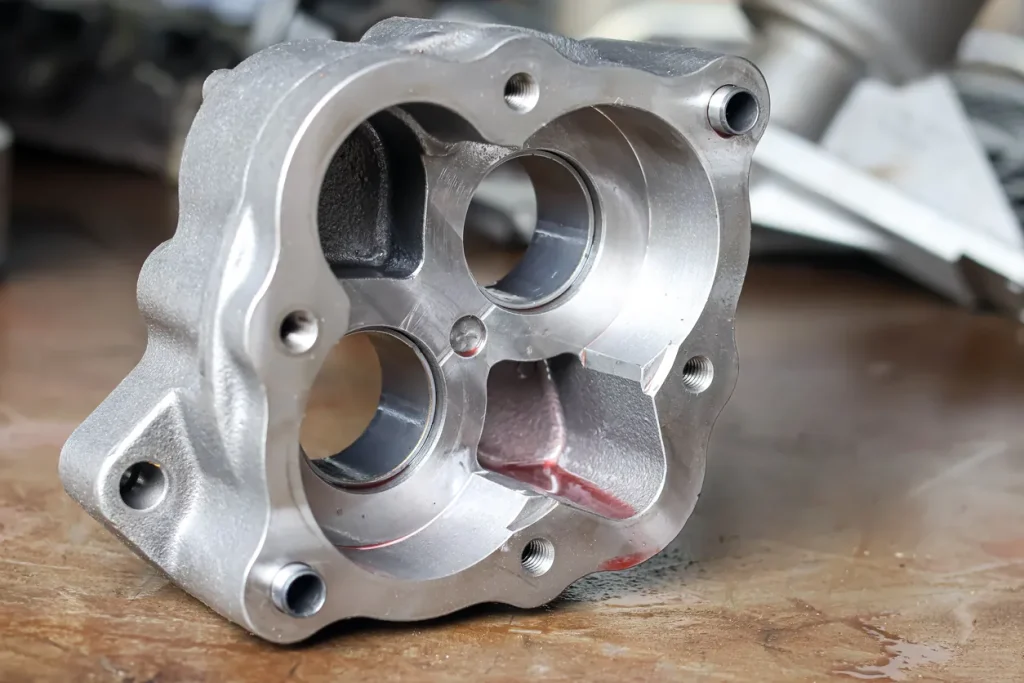
Critical to quality characteristics define the measurable part attributes and process-tied specifications that need to be met so a cast part functions as it should. Dimensional accuracy, internal soundness, mechanical and material properties, surface finish, and cleanliness are all part of critical to quality characteristics, but how do you find them?
General Die Casters’ guide shows exactly the steps to take to locate CTQs and why identifying them matters.
Start With Function and Failure Consequences
Identifying critical to quality characteristics starts with looking at the part function and examining failure consequences. Begin with reviewing a drawing, 3D model, mating components, and service requirements with design, manufacturing, quality, and the manufacturer. Consider these questions
- What does this feature need to accomplish?
- What happens if it is out of specification?
- Which measurable characteristic determines whether it works?
- Does the requirement apply as-cast, after machining, or after finishing?
Map the Function to Specific Characteristics
| Functional Requirement | Candidate CTQ Characteristic | Possible Verification |
|---|---|---|
| Assembly and location | Mounting hole position, datum relationships, interface profile, pad flatness | CMM, gauges, or functional fixtures |
| Bearing or shaft support | Bore diameter, location, and alignment to related features | Bore measurement and CMM |
| Sealing and pressure containment | Sealing-land flatness and finish, local wall integrity, permitted leakage | Surface measurement, leak testing, targeted internal inspection |
| Fastening | Thread size and depth, boss geometry, soundness around threaded regions | Thread gauges, dimensional inspection, appropriate internal quality checks |
| Structural performance | Required wall thickness, load-path geometry, alloy/material requirements, discontinuities in stressed regions | Dimensional checks, material verification, specified mechanical testing or nondestructive inspection |
| Appearance and clearance | Defined visible surface condition, flash or gate removal limits where function or appearance requires them | Visual standards and dimensional checks |
Screen for Die Casting Specific Risks
Review where the casting process could threaten those functional requirements starting with thick sections and abrupt wall transitions. With those considerations, assess shrinkage, internal soundness, and distortion risks.
Assess filling and minimum finished wall requirements for thin walls and ribs in a die cast part. For parting lines and moving cores, check mismatch, flash, and their impacts on functional geometry. Ensure the remnants for gates and ejector locations do not compromise sealing, assembly, or specified appearance.
Review machining allowance and the possibility of exposing subsurface defects on machined bores, faces, and threads.
Turn Critical to Quality Characteristics into Measurable Acceptance Requirements
For each selected characteristic, document:
- The feature identifier and applicable datum reference
- The dimension, geometric tolerance, surface requirement, material requirement, or functional limit
- The acceptance criteria and the region to which they apply
- The inspection method and manufacturing stage
- The sampling or production-control requirement
Validate the Features and their Controls on Actual Parts
Confirm the selected critical to quality characteristics after operations that can impact them rather than immediately after casting. Where distortion matters, compare as-cast and post machining geometry while rechecking machined functional interfaces. Use CMM or suitable gauges for geometry, targeted X-ray or CT for internal quality management.
When the approved critical to quality characteristics are confirmed, carry those into the production inspection and process control plan with agreed upon sampling and traceability.
General Die Casters, Paying Attention to Critical to Quality Characteristics Since 1957
General Die Casters is the custom aluminum die casting manufacturer that OEMs, supplier programs, and other customer sources have trusted since 1957. Located in Twinsburg, Ohio, our team of operators, engineers, and senior leadership allows us to pay close attention to all the critical-to-quality characteristics in each manufacturing program.
Properly identifying these characteristics all takes place with our pre-manufacturing engineering. We utilize various types of software to help enhance a design and by doing so, properly establish the critical to quality characteristics in each cast.
General Die Casters adheres to all standards set forth by the North American Die Casting Association (NADCA) and we have been ISO 9001 certified for many years now.
Contact our team today for more information on how to properly identify critical to quality characteristics and trust General Die Casters for your aluminum die casting needs.