
TL;DR: For most die cast parts, an aluminum alloy in the 380 family, such as 383, provides the best balance of strength, cost, and castability. Specialized needs such as heat and wear resistance, corrosion resistance, pressure tightness, or high structural loads may call for B390, 360, 413, or a structural alloy.
“What alloy should I use for my casting?” It’s one of the most frequently asked questions we receive at General Die Casters, and it’s one we’re always happy to answer. The alloy used in your casting affects the final properties, function, and price of the part, along with the life of your die cast tool.
Choosing between aluminum die casting alloys doesn’t have to be complicated. Most parts are well served by one common alloy, and only a few specific requirements call for something more specialized.
General Die Casters breaks down how to choose the right alloy for your part, starting with a simple checklist.
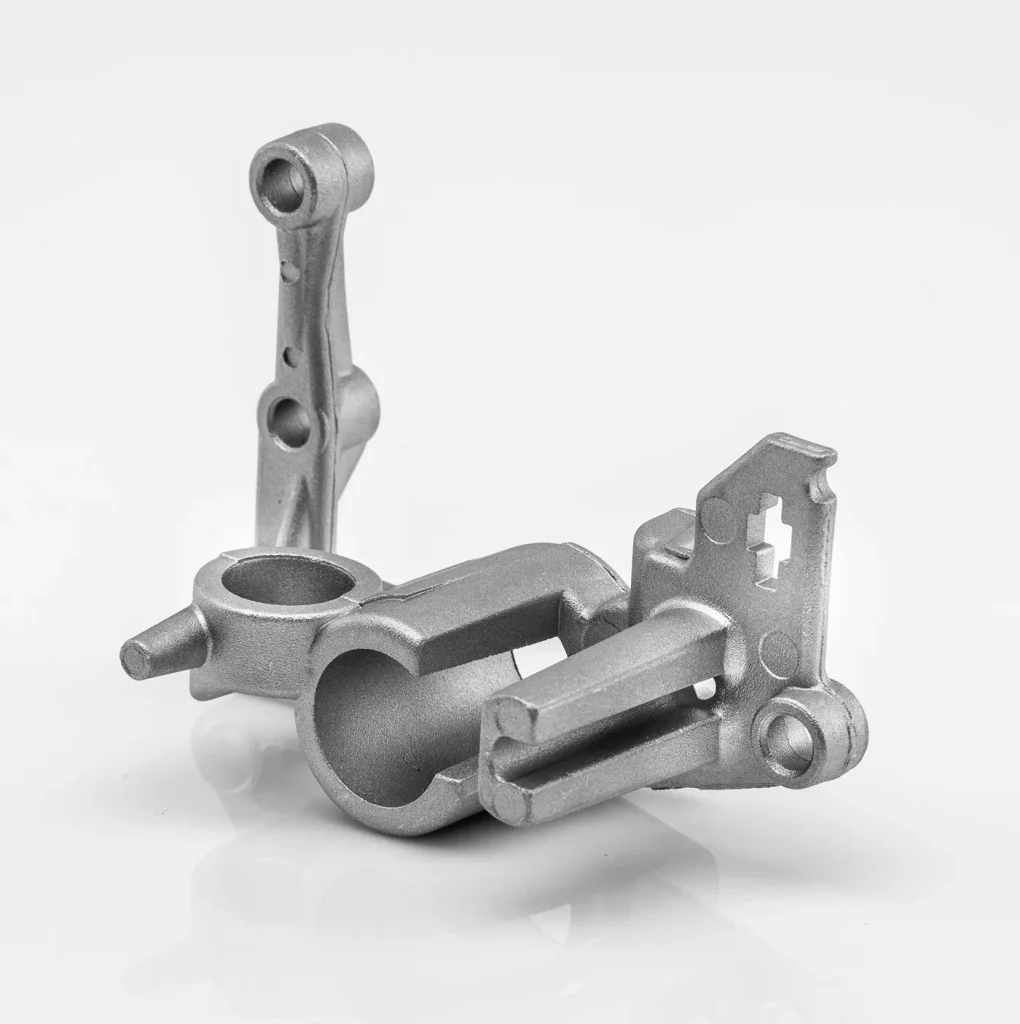
An automotive part die cast in 383, one of the go-to alloys for most applications.
Quick Answer: Which Die Casting Alloy Should You Use?
For most parts, an alloy from the 380 family, such as 380 or 383, is the right choice. It offers good strength, the lowest cost per pound, and easy casting. A more specialized alloy only makes sense if your part needs:
- Heat and wear resistance: B390
- Corrosion resistance: 360
- Pressure tightness: 413
- Structural strength under high loads: a structural alloy
Six Questions to Ask Before You Choose
Before comparing alloys, answer the following questions to narrow down your search:
- Will your casting experience wear from motion against another part?
- Will your casting reach temperatures above 500°F during use?
- Will your casting spend its life outside, exposed to water and salt?
- Does your casting need to be pressure tight?
- Will your casting experience high loads and function as a structural component?
- Will your casting require heat treating?
If you answered “no” to all these questions, an alloy in the 380 family is the way to go. If you answered “yes” to any of them, a more specialized alloy should be considered.
Comparing Common Aluminum Die Casting Alloys
| If your part needs | Consider | Why |
|---|---|---|
| No special requirements | 380 family (383) | Good strength, lowest cost, easy to cast |
| Heat and wear resistance | B390 | 16-18% silicon forms hard, wear-resistant crystals |
| Corrosion resistance | 360 | No more than 0.6% copper |
| Pressure tightness | 413 | Narrowest solidification range, deep sound skin |
| Structural strength | Structural alloys | Manganese in place of iron, strontium for ductility |
Why the 380 Family Works for Most Parts
380 and 383 alloy are ideal for several reasons:
- It produces castings with very good mechanical properties that meet the requirements of most applications.
- It has the lowest price per pound because its chemical composition is very common in the secondary aluminum recycle stream.
- It’s a friendly alloy for the die caster. It fills cavities well, minimizes soldering, and can be held at lower temperatures than other alloys.
High Temperature and Wear Resistance: B390
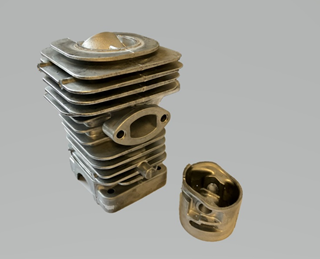
If your casting will experience high temperatures and be used in a wear application, B390 alloy is an excellent choice. B390 is used to produce components such as engine cylinders, pistons, pumps, pulleys, and brake systems.
B390 is considered a hypereutectic alloy because it has between 16-18% silicon. Above roughly 12.6% silicon, the extra silicon forms hard crystals as the metal cools. Those crystals act as a hard bearing material for wear and strengthen the casting at high temperatures.
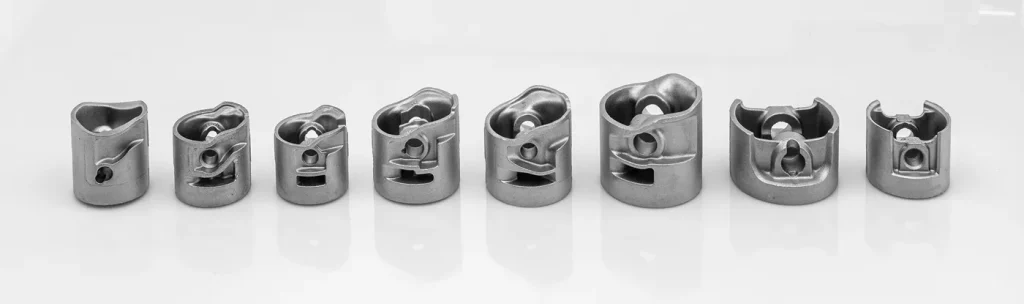
Pistons see high heat and constant wear, which makes them a common use for B390 alloy.
Challenges to Consider with B390
B390 is an excellent material in the right application, but it does come with certain challenges:
- Machining: The primary silicon crystals wear machining tools more quickly than a typical 380 family casting.
- Melt treatment: Improper melt treatment causes the silicon crystals to fuse together. If they grow beyond 150 microns, they can cause significant tool wear and even stress risers in the casting.
- Tool life: The molten material must be held above 1300°F. The higher temperatures and free-floating silicon crystals cause significant wear to the die, cold chamber, and melting furnaces.
It’s important to note that you can expect at least 20% less tool life using B390 than you would with 380 alloy.
Corrosion Resistance: 360
Will your casting spend its life outside and need to resist corrosion? Copper in aluminum reduces corrosion resistance. 360 alloy, with no more than 0.6% copper, is an excellent choice for castings with this requirement. Marine components and pumps are frequently produced from 360 alloy for this reason, and the right coating can add another layer of protection.
Pressure-Tight Applications: 413
413 alloy is the aluminum-silicon eutectic alloy, which means it solidifies over the narrowest range of any common die casting alloy.
Aluminum castings begin to solidify at the die surface, and the process continues inward toward the thermal center of the casting. That solidification front produces a sound skin that is pressure tight. Since 413 solidifies in such a tight range, the pressure-tight skin extends much deeper into the casting than it does with other alloys.
A casting produced from the 380 family can also be pressure tight if the part is designed with this in mind and the skin isn’t removed by a secondary machining process.
Structural Die Casting Alloys
New alloys have been developed that allow die castings to be used for structural parts. Examples include automotive body components such as shock mounts, door panels, and engine cradles. Structural alloys are also frequently found in frames for the marine and off-road recreation industries.
Structural castings experience high mechanical loads during use and can be welded or riveted during assembly.
Iron is a necessary impurity in most aluminum alloys used for die casting because it prevents the aluminum from soldering to the die steel during casting. However, iron also forms brittle particles in the metal. Structural alloys replace iron with manganese to prevent soldering and add strontium to improve ductility. The result is a part that can bend under load instead of cracking.
Find the Right Alloy With General Die Casters
Alloys play a huge role in the overall cost and performance of your casting and your die cast tool. We developed this checklist to help you get started, but it’s important to speak with your die caster about your casting’s specific requirements to determine the best alloy for your application.
Interested in discussing your next die casting project? Contact General Die Casters today to get started.
Frequently Asked Questions About Die Casting Alloys
What is the most common aluminum die casting alloy?
The 380 family, 380 and 383. It meets the requirements of most applications and has the lowest price per pound.
Which die casting alloy is best for pressure-tight parts?
413 alloy. Its pressure-tight skin extends deeper into the casting than other alloys. A 380 family casting can also work if the part is designed for it and machining doesn’t remove the skin.
Why does B390 cost more to produce?
B390 must be held above 1300°F, and its silicon crystals wear the die, cold chamber, furnaces, and machining tools. Expect at least 20% less tool life than with 380 alloy.